
The policy dispute
Solar Energy UK chief executive Chris Hewett has urged the Conservatives to retain a policy he says they helped develop. According to Roofing Today, he argued that solar panels and batteries give households greater control over their energy costs. The outlet reported the trade body's response on 5 October 2026.
The association also challenged the case that reducing construction costs would make homes cheaper to buy. It said housing prices were determined by supply and demand, with new homes attracting a small premium. In its assessment, lower building costs would increase housebuilders' margins rather than reduce buyers' costs.
Public interest in rooftop generation extends across political groups, according to survey findings cited by the association. It said research by More in Common found that more than half of Britons either had solar panels at home or wanted them, with little difference between political preferences.
Requirements for new homes
The Future Homes Standard requires carbon emissions from homes to be at least 75% below those permitted under the 2013 Building Standards, Roofing Today reported. The outlet described that threshold as effectively ruling out fossil-fuelled heating.
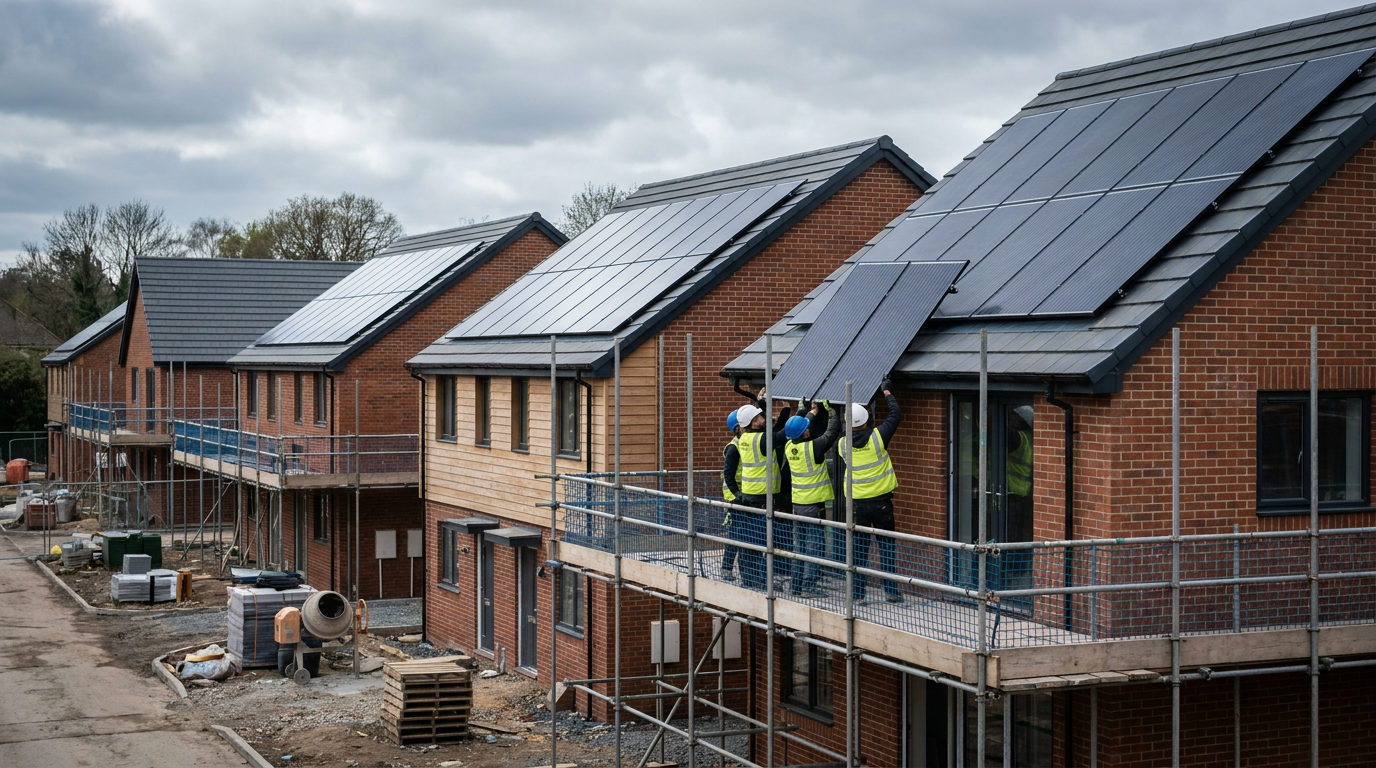
The rules also largely require solar panels with an area equivalent to at least two fifths of a home's floor area. That measure relates to floor space, rather than the proportion of the roof covered by panels.
Hewett said existing regulations had already led to more than half of new homes being designed with solar generation. His argument for retaining the standard therefore concerned both the forthcoming requirements and the continuation of an approach already used in new housing.
Evidence on energy use
The report cited a Centre for Net Zero study involving a randomised trial of home solar and battery installations. Over one year, net electricity imports from the grid fell by 77%, while household bills were reduced by 62%.
The study also recorded a 66% reduction in electricity drawn from the grid at peak times. Roofing Today reported that the systems continued to make a significant difference during winter. The findings concerned solar and batteries together, rather than solar panels alone.
At a national level, Solar Energy UK cited Carbon Brief analysis estimating that wind and solar had avoided almost £6bn in UK gas expenditure since the start of the Hormuz Crisis. The association described the gas saving as equivalent to the cargoes of 100 liquefied natural gas carriers. That estimate covered wind and solar together, not just domestic rooftop installations.
Hewett linked the housing standard to reduced dependence on imported natural gas. He said homes with lower running costs and lower carbon emissions would also be less exposed to geopolitical disruption affecting fuel supplies. The association identified rooftop solar, including systems on homes, as part of that wider energy mix.
Implementation dates
The regulations are due to take effect on 24 March 2027 for most homes, with flats following six months later. Roofing Today reported that a transition period would continue until 24 March 2028. After that point, projects without prior planning permission or submitted initial notices must comply.
The association also distinguished the housing policy from the Future Buildings Standard, which covers non-residential properties. It said the Conservatives appeared not to have addressed that separate standard in their position on the housing rules.