
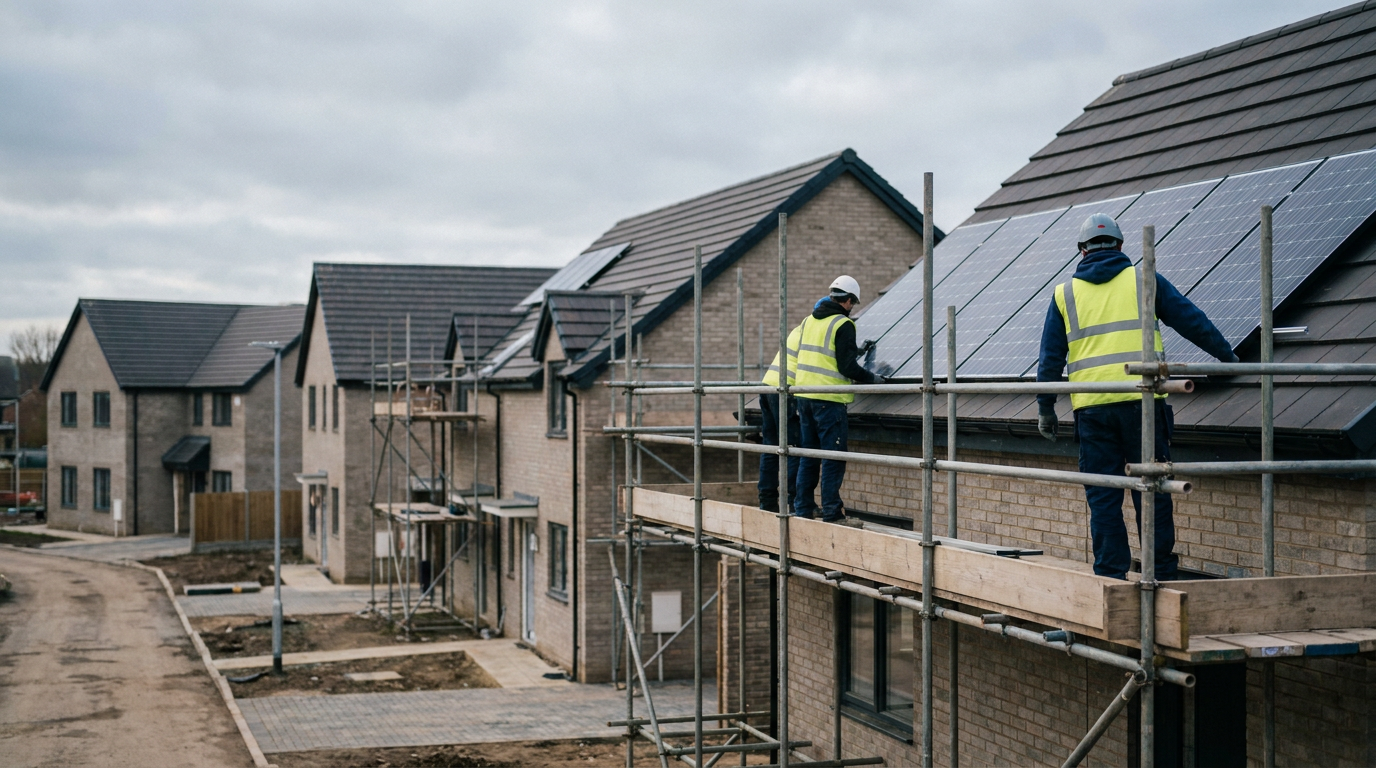
New homes drive rooftop demand
New-build properties accounted for more than half of England’s MCS-certified solar installations recorded so far in 2026, according to Roofing Today. The figures put housebuilding at the centre of the small-scale rooftop solar market, rather than demand being confined to owners adding panels to existing buildings.
Government figures cited in the report cover 98,222 homes built in England during the first six months of the year. The longer-term figures show how solar provision has changed: panels were installed on 16% of new homes in 2021, compared with 42% in the final quarter of 2024.
Roofing Today links the increase to tighter energy efficiency requirements, alongside households and businesses seeking to reduce their energy bills. It identifies the Part L requirements introduced under the Building Regulations in 2022 as a factor behind the more recent acceleration in installations on new homes.
The available figures do not provide the same breakdown for non-domestic buildings. There is therefore no equivalent measure in the report showing how frequently panels are being fitted to newly built commercial premises.
How the installation figures compare
MCS, the UK quality mark for small-scale renewable energy systems, recorded 207,619 certified solar installations during 2026 by the time Roofing Today published its report on 14 September. That is above the 203,697 installations completed during the whole of 2011, a benchmark that stood for nearly 15 years.
The annual record nevertheless remains with 2025, when 269,195 installations were recorded. This year’s total had not yet passed that figure. A further annual record depends on the pace of work continuing through the remaining months of 2026.
Chris Hewett, chief executive of Solar Energy UK, said most of the installations expected this year would be on homes. He contrasted current activity with 2020, when just 21,200 systems were installed over the entire year. He said that annual figure would now represent a relatively quiet month.
The MCS total covers small-scale systems, not the whole rooftop solar sector. Commercial-scale installations on buildings such as factories, warehouses and supermarkets fall outside its figures. Roofing Today reports that those installations are also outside the development planning system, making their number harder to establish.
That distinction matters when reading the installation count. The annual forecast covers homes and other buildings, including schools and village halls, but it is not a complete measure of rooftop solar work across all building types and system sizes.
The installed base and energy bills
The UK now has more than 2.1 million MCS-certified solar systems. Systems within this category have generating capacity of up to 50 kilowatts, although the average is about a tenth of that ceiling. A typical home installation has between 3kW and 5kW of panels.
The pace of accumulation has also changed. The first million certified installations were registered between January 2009 and July 2019, a period of more than a decade. The total reached two million in April 2026, less than seven years after the first million milestone.
Roofing Today reports that the installed base could reach three million within a further three years if the current trajectory continues. That is a projection based on the recent rate of installation, rather than a confirmed delivery programme.
The report also links a rise in consumer enquiries during the spring to energy price increases associated with the Iran War earlier in the year. It says that additional interest is now being reflected in completed installations.
Hewett attributed demand to continuing high energy bills and the UK’s reliance on natural gas. He said rooftop generation offered households a way to reduce those bills. The report did not give a financial saving for a typical installation.
Certification and future building requirements
Lisa Cooke, managing director of MCS, said growth was continuing after the record annual total in 2025. She linked uptake to consumers’ confidence in certified products and installers, and said MCS had redeveloped its scheme with the aim of strengthening household protection.
Building standards are another part of the industry’s outlook. Hewett said the forthcoming Future Homes Standard and Future Buildings Standard would make rooftop solar effectively a requirement in England. His comments described the expected effect of the standards, rather than presenting them as requirements already in force.
Hewett also pointed to plans in Wales to make solar panels a functional requirement for new buildings, with the scope extending to new roofs and renovations a year later. That would bring roof work on existing buildings into the changes he described, alongside the new-build market.