What happened
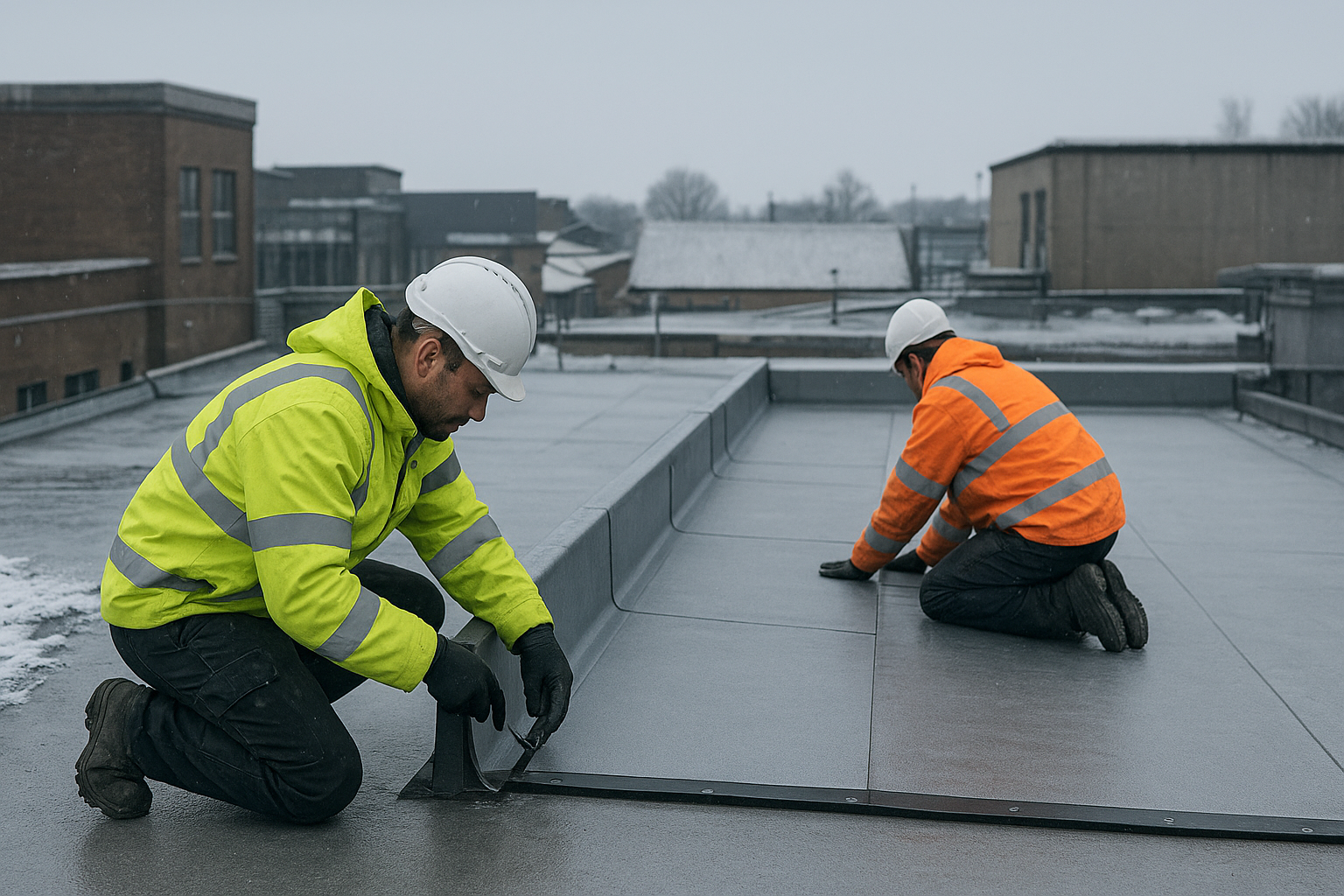
Garland UK completed a major roof refurbishment at the Carlsberg Britvic Brewery in Northampton with Cambridge Flat Roofing as the approved contractor. The work covered over 13,000 square metres of roofing. The project adopted a fully flame-free specification in line with NFRC Safe2Torch guidance and insurer requirements.
A no-hot-works policy was in place for the entire operational brewery, so traditional torch-on methods were not permitted. Installers faced technical challenges due to the brewery's steep vertical planes and complex geometry. Winter working conditions added further constraints, especially regarding moisture management and sequencing.
Garland UK, acting as system designer and technical lead, supplied the StressPly Flex SA system. This system uses self-adhesive modified bitumen membranes, hot air welding, and solvent-free adhesives. The technical team included Andrew Fox, Technical Manager at Garland UK.
Mechanically fixed A1 fire-rated, non-combustible boards formed part of the roof build-up, securely fixed into the concrete deck following site-specific pull-out tests. All system components were mechanically restrained, and restraint bars were installed across the head laps at each of the 141 vertical upstands. This approach protected the membrane against future movement.
The team completed over 4.5 kilometres of restraint detailing. Garland UK coordinated technical detailing strategies with Cambridge Flat Roofing throughout and maintained quality control via regular site inspections. Moisture management during installation was achieved using ETorches, a flame-free drying method, ensuring safety and continuity during winter works. The new roof aims to deliver long-term waterproofing and fire safety performance.
The background
The Carlsberg Britvic Brewery was designed in the 1970s. Its architecture is inspired by a Danish longship, with a roofscape defined by steep vertical surfaces, complex geometry, and high exposure. This complexity, combined with legacy construction techniques, posed risks around long-term waterproofing and durability.
The client's brief was to improve the durability and waterproofing of more than 13,000m² of existing roof covings. Legacy construction and exposure led to an increased focus on the building's many vertical slopes and interfaces. Risk of water ingress and membrane movement over steep and vertical surfaces needed to be addressed. Further, the roof needed to comply with fire safety regulations and be compatible with future upgrades, such as potential solar installations.
No-hot-works procedures are increasingly required by insurers and clients to protect against the risk of fire during construction on occupied sites. These restrictions remove traditional hot-applied roofing methods and increase demand for flame-free installation alternatives.
What people are saying
Andrew Fox, Garland UK’s Technical Manager, said that "absolute technical control" was essential for the project due to its scale, vertical detailing, and the ban on hot works. Every decision made on the project had to be technically verified. Fox described the project as requiring close technical oversight throughout installation.
Garland UK stated that all elements of the flame-free system were mechanically fixed. The technical delivery included site-specific pull-out tests to confirm correct fixing depth and strength. Stainless steel fixings were specified to mitigate corrosion risks over the long term.
The contractor, Cambridge Flat Roofing, worked alongside Garland UK throughout delivery. Garland UK maintained responsibility for system design, strategy, technical oversight, and quality control, from pre-construction through to project completion.
The client, Carlsberg Britvic, required that the approach be compliant with both NFRC Safe2Torch guidance and their own insurance requirements. Detailed vertical waterproofing interfaces required individual consideration, rather than standardised detailing.
What happens next
The newly refurbished roof is designed to deliver long-term waterproofing and fire safety. The use of restraint bars at each upstand and the selection of non-combustible A1 boards and stainless steel fixings are intended to prevent membrane movement and ensure compliance over time.
The installation has eliminated hot-work related risks, meeting insurer and NFRC guidance for flame-free methods. The roof is compatible with potential future additions, such as solar PV systems, according to project documentation.
Garland UK’s delivery includes full technical support going forward and is expected to offer continued compliance with fire safety regulations and long-term existing building upgrades. No information is provided on further planned works or additional contractor requirements at this stage.