
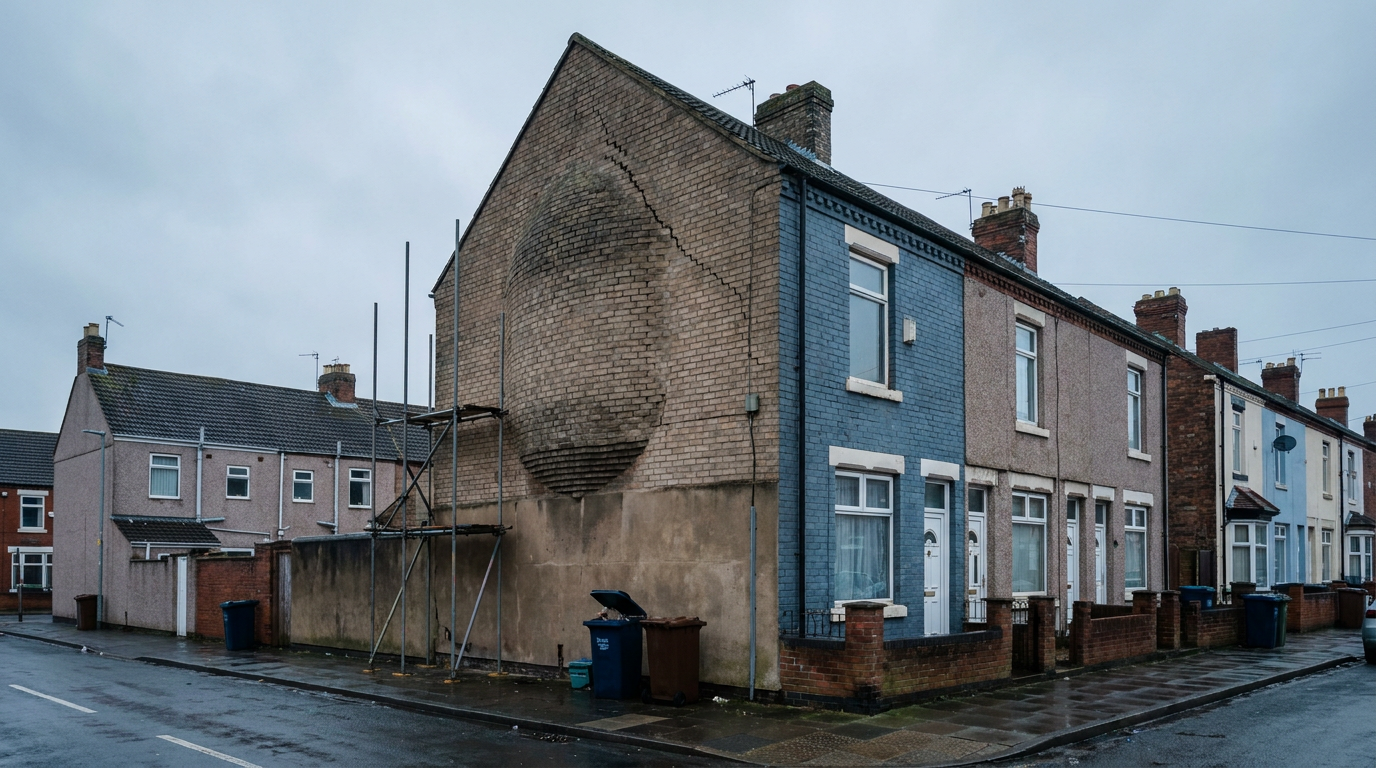
Wall ties failed beneath the gable
Clarice Berry, 77, died from chest injuries when about 3,800kg of masonry fell at her home on 18 July 2021. According to the Daily Mail, a prevention of future deaths report by Manchester West assistant coroner Bronia Hartley set out failures in the handling of concerns about the building.
Investigators examining the collapse found that a series of wall ties had failed completely. Those ties were in the upper section of the cavity wall, beneath the gable. The failure had caused the brickwork to bow outwards.
Evidence heard at the inquest indicated that collapse was unavoidable without repairs. The report also recorded evidence that the wall was unlikely to have survived another winter if it had remained standing beyond that July.
The property was an end-of-terrace house in Greater Manchester. It belonged to S&G Properties (No2) Limited and was managed by KMPM at the time of Mrs Berry's death. The report examined both the ownership and management arrangements, including how earlier repair concerns had been handled.
How the warnings were handled
The report said signs of cavity wall tie erosion were present from 2013. Mrs Berry's husband had alerted a previous managing agent to the bowing wall, but that concern was not carried forward when Kaye Mackenzie took over management of the property.
A Kaye Mackenzie property manager visited in August 2013. His inspection note described a substantial bulge in the gable and identified repointing or rebuilding as an urgent requirement. It was a written record of the defect as well as a recommendation for work.
The same manager returned in March 2016. On that occasion, his notes again identified the gable as needing repointing. Despite the two recorded inspections, the report found that the defective brickwork was not monitored. Neither a structural engineer nor a quantity surveyor was appointed to investigate it.
Kaye Mackenzie was wound up in January 2020, when the property manager retired. One of the firm's former partners continued its property management work through KMPM.
The bulge was brought to someone's attention again around February or March 2021. This time it was pointed out to a gas engineer who was installing a replacement boiler at the house. The coroner recorded that no work on the wall followed that warning.
Findings on inspections and hazard checks
Ms Hartley said a competent managing agent or responsible landlord should, at a minimum, have arranged checks for any worsening of the wall's condition. In her assessment, a structural survey should have been commissioned by 2018 at the latest. That finding placed a deadline for investigation several years before the final warning to the gas engineer.
The coroner also found that neither the landlord nor the managing company had followed government guidance intended to reduce potential hazards. Her concerns extended beyond the handling of this particular repair to the arrangements for recognising and responding to serious defects during a tenancy.
The report identified an absence of clear systems to prevent a similar sequence of events. It addressed two circumstances: a tenant reporting a serious hazard without receiving an appropriate and timely response, and a hazard developing without the tenant identifying it.
Ms Hartley further found that neither company had carried out a post-incident assessment to establish whether its properties contained other serious unresolved hazards that had not come to the local authority's attention. This was a separate concern from the absence of monitoring and investigation at Mrs Berry's home.
What the companies said
In its response, S&G Properties (No2) Limited said it had arranged independent inspections across all its residential properties. The company presented those arrangements as one of the measures it had taken following the death.
A director of the landlord company also expressed sadness over Mrs Berry's death. The director's name was redacted in the response reported by the Daily Mail on 17 September 2026.
KMPM said it had reviewed its property management procedures and introduced changes covering inspections, the identification of hazards and the escalation of concerns. Its response also described changes to compliance monitoring and project management procedures.