
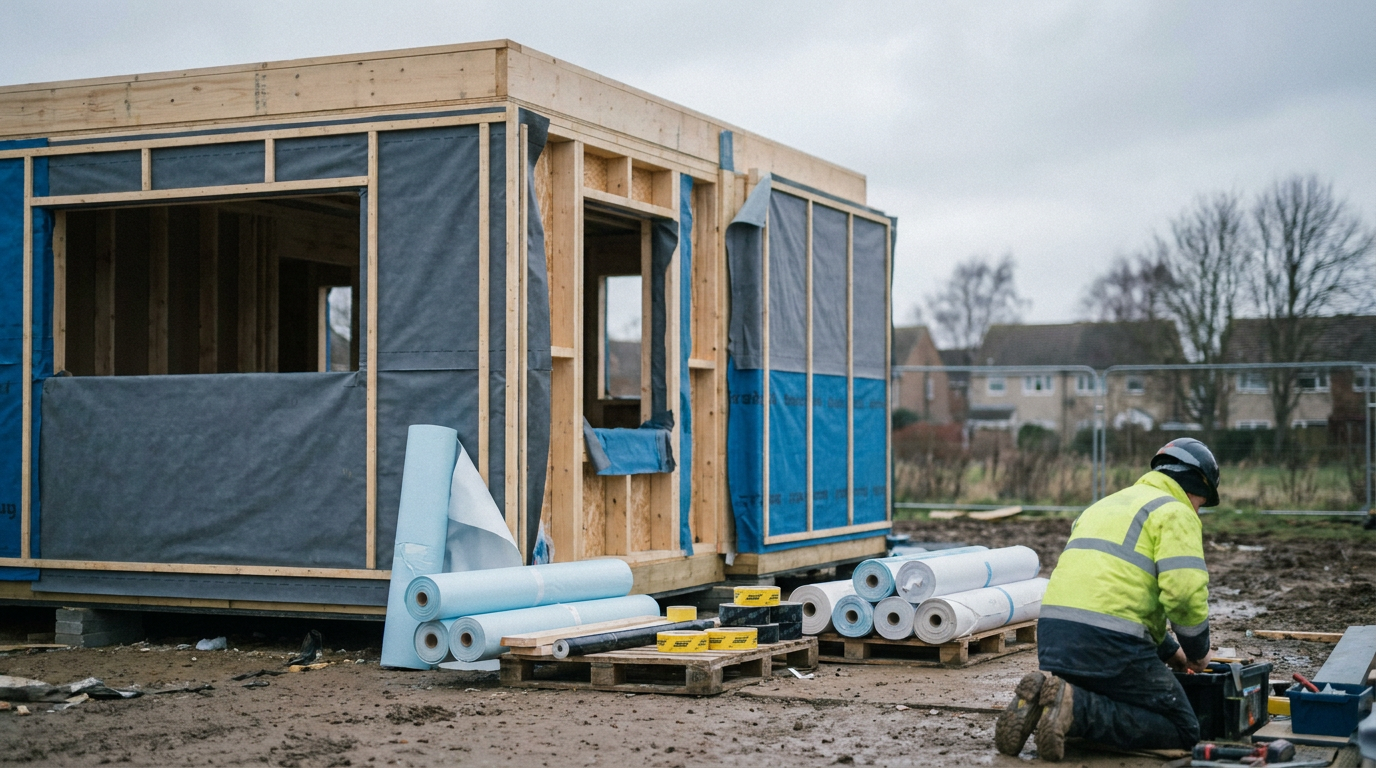
Membranes and specification
Proctor Group has supplied three types of membrane, together with tapes and accessories, without charge for Social Bite’s village programme, according to Roofing Today. The company also provided technical advice during the design and specification process.
Richard Miller, Social Bite’s project manager, said the charity approached suppliers already used by its modular manufacturer. The aim was to retain a supply chain familiar to Ecosystems Technologies. Miller said those businesses had supported the programme and acknowledged Proctor Group’s help with both products and technical questions.
Owen Young, production director at Ecosystems Technologies, said Proctor Group membranes were already a regular specification for the manufacturer. Roofing Today reported that the recommendation reflected the company’s approach to material selection and local sourcing.
Proctor Group managing director Keira Proctor said the decision to contribute products reflected the company’s commitments to community support and sustainability.
How the timber homes are made
Ecosystems Technologies works with partners to manufacture cross-laminated timber (CLT) panels using a vacuum press. Roofing Today reported that the business uses this method across its modular products and sources only Scottish-grown timber. The report linked that sourcing policy to timber traceability and reduced transport requirements.
The manufacturer produced a prototype of its one-bedroom Nest home in 2023. Young said the prototype allowed people to understand the proposed accommodation and helped the project attract further charitable backing.
Miller said the design developed through collaboration between the charity and manufacturer. Ecosystems Technologies proposed building concepts and provided technical guidance. Social Bite also used its own architects and engineers to check that the designs met relevant regulations.
Roofing Today described the offsite process as protecting production from the weather and limiting the finishing work needed after manufacture. It also reported benefits for consistency, time spent on site and building fabric performance. Young said the manufacturer’s modular buildings were in use across Europe, including northern Scotland and southern France.
Edinburgh move and new villages
The Edinburgh village opened in 2018 as a supported community for 20 people. By the time of Roofing Today’s report on 17 September 2026, it had accommodated 100 people experiencing homelessness on a transitional basis.
The lease on that site is approaching its end. Social Bite has worked with the local council to identify another location in Edinburgh. The move will include transferring the 11 existing two-bedroom living units rather than replacing the whole development with new accommodation.
Plans for the replacement site also include five additional one-bedroom Nest homes. A community building will be assembled from six modules, alongside the relocated and new residential units.
Separate villages are being developed in South Lanarkshire and Dundee. Roofing Today reported that the housing model was expected to operate across three sites by the end of 2026.
Housing and resident support
Social Bite operates as both a charity and a social business. Its work supporting people to leave homelessness dates from 2012. The village model combines accommodation with support and wellbeing activities while residents wait for permanent housing.
Roofing Today put the number of people in temporary accommodation in Scotland at more than 17,000. Its report described some residents facing long stays, isolation, curfews and a lack of suitable cooking facilities. Social Bite’s approach includes opportunities to develop skills and confidence within a supported community.