What happened
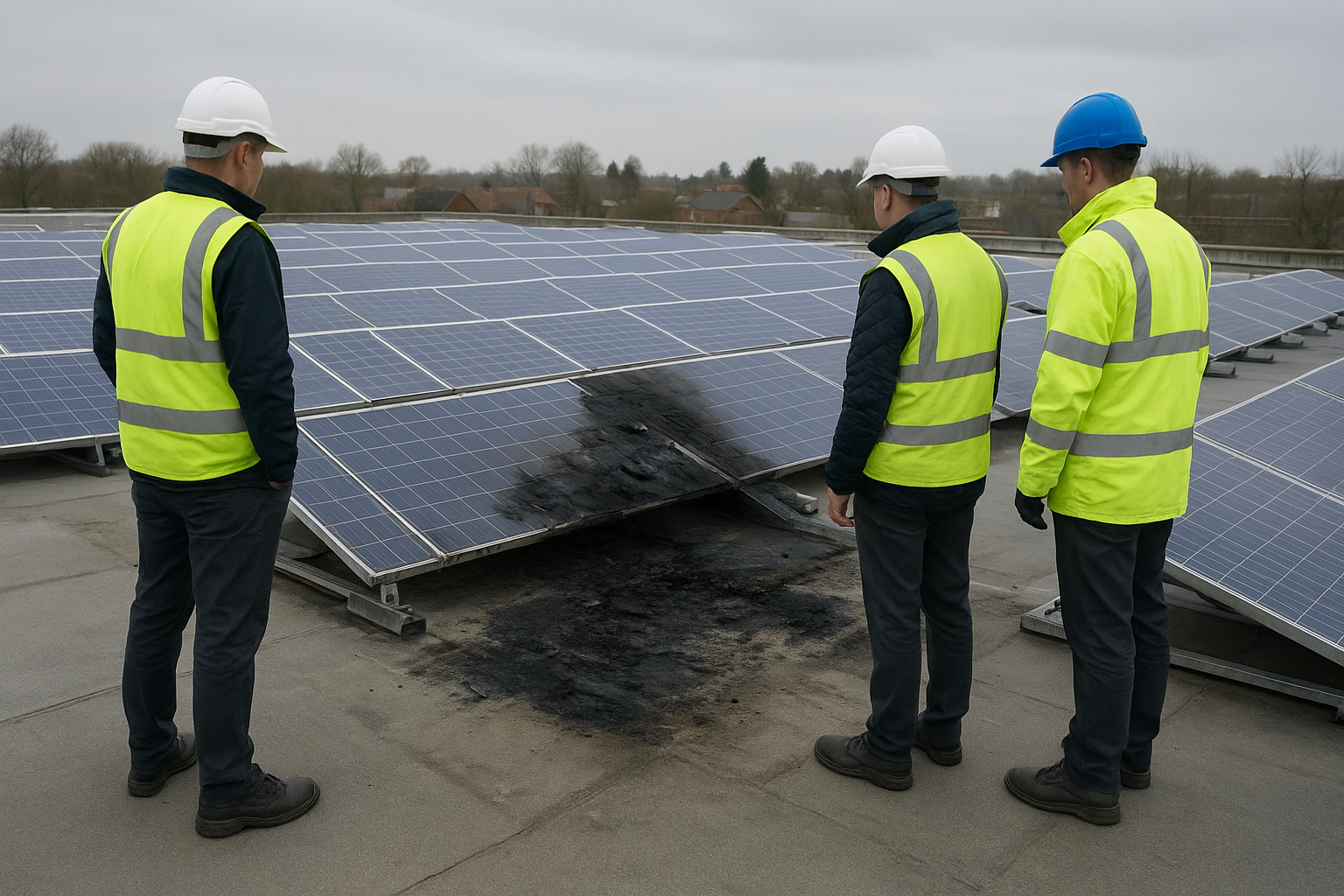
The Fire Protection Association (FPA) completed fire tests on two types of insulation beneath photovoltaic (PV) arrays mounted on flat roofs with reinforced bituminous membranes. Tests took place at the FPA's research facility in Gloucestershire. The objective was to examine fire development and spread within the roof assembly when exposed to a fire originating under the PV system.
The FPA released the full report earlier this year, including detailed methodology and results. These results are intended to provide insurers and underwriters with technical evidence rather than relying on assumptions when assessing risks related to rooftop PV installations.
According to the findings, significant fire spread occurred across the bituminous cap sheet and PV modules in both scenarios, regardless of insulation type. This highlights the importance of evaluating complete roof assemblies for fire risk, rather than focusing solely on the insulation products.
The background
Flat roofs on commercial buildings are increasingly used for mounting PV modules. These assemblies commonly include insulation layers beneath reinforced bituminous membranes. The two insulation types studied were polyisocyanurate (PIR) and stone wool.
Fire risk beneath PV arrays has become a standard concern among insurers. The performance of roof assemblies under fire conditions has significant implications for building insurance and underwriting. Historically, risk assessments have focused on the properties of individual materials within the roof build-up.
The Insulation Manufacturers Association (IMA) supports the FPA's approach, which seeks to inform fire safety decisions through full system testing. Simon Storer, chief executive of the IMA, noted that the findings reinforce the need to consider roof systems as a whole when evaluating fire performance.
What people are saying
Simon Storer of the IMA said the FPA report gives industry evidence to underpin fire safety decisions for flat roof PV installations. He said the industry needs more such system-level data as PV becomes more common on commercial buildings. Storer encouraged insurers, underwriters and risk professionals to review the FPA's report for a full understanding of fire risks for rooftop PV.
The report provides data-driven evidence that insurers can use to support informed underwriting. Previously, many insurers have relied on assumed performance based on the materials used. The IMA has also published a summary document outlining findings specific to the fire performance of thermal insulation in these assemblies.
What happens next
The FPA’s published evidence is intended to inform those responsible for insuring commercial buildings with PV systems installed on flat roofs. Insurers are expected to use the results to move away from making assumptions based on individual material properties and instead consider the fire performance of complete roof assemblies.
Risk professionals and the wider insurance industry have been encouraged by the IMA to consult the FPA report before making underwriting decisions on buildings with rooftop PV. The IMA is making its summary available to provide a concise view of the test outcomes and practical implications for the market.
Future insurance decisions about commercial flat roofs fitted with PV systems may increasingly be based on empirical fire test data like that provided by the FPA. This shift could influence both the design of roof assemblies and the conditions under which insurers agree to provide cover for commercial premises with solar arrays.