What happened
Contractors selected DensDeck Prime Roof Board as the recovery board for the refurbishment of two flat roofs on mission-critical buildings owned by an international microprocessor manufacturer in Malaysia, according to Roofing Today. The total roof area is 50,000m². The refurbishment was necessary because the existing coverings had reached the end of their service life. The buildings needed to remain fully operational throughout the work.
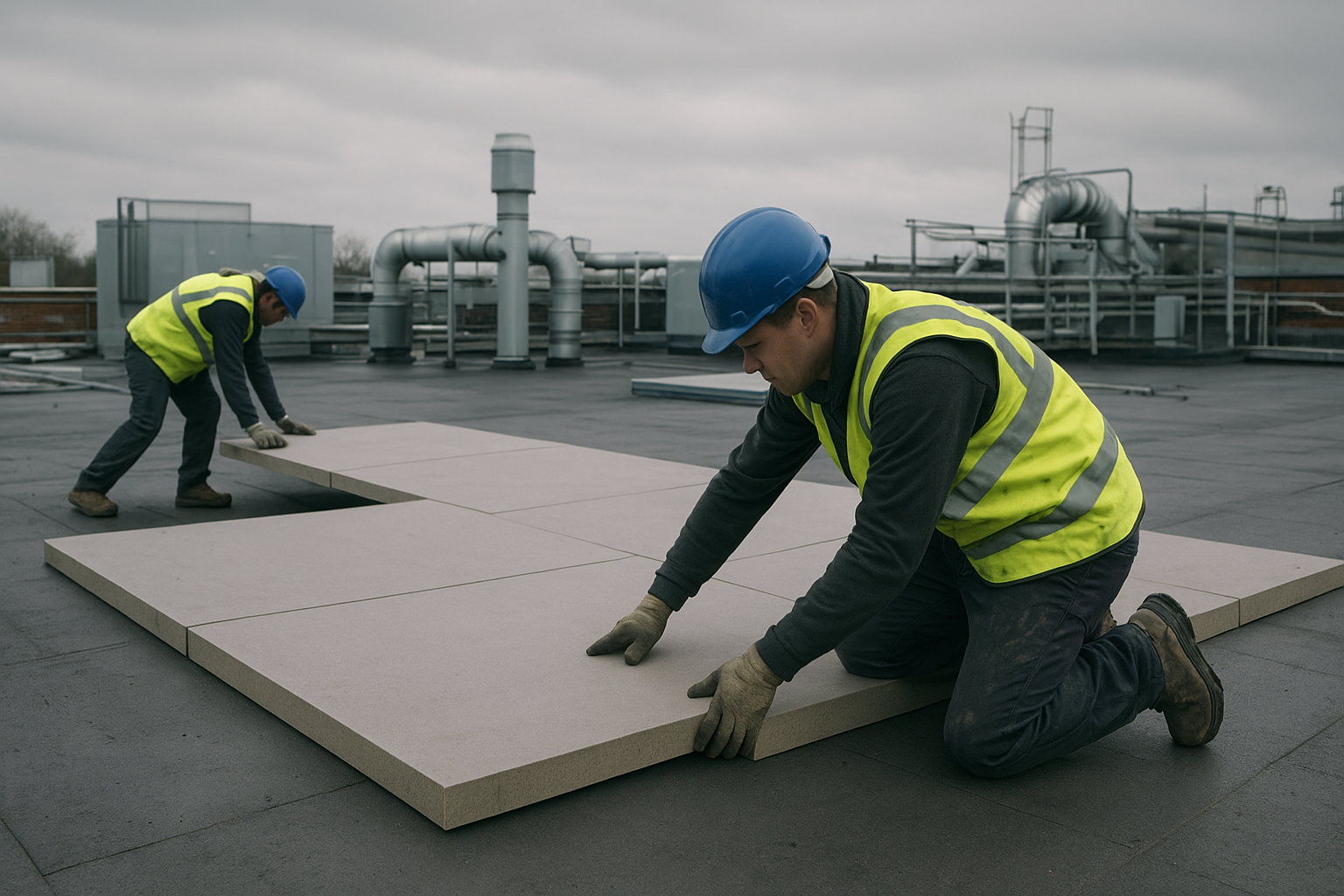
The contractors used a mechanically fixed system: they installed DensDeck Prime Roof Board directly over the existing roof structure, then placed a new single-ply membrane above. The project required the roofing system to comply with international insurance standards, particularly FM Approval.
The background
Malaysia’s humid and monsoon-prone climate presents particular challenges for flat roofing, including water ingress, mould growth, and dimensional instability. Roofing Today reports that the project team considered locally produced cement composite boards but chose DensDeck Prime Roof Board for its performance in these areas. The board has demonstrated strong dimensional stability and high mould resistance according to ASTM D3273, which proved advantageous for this climate.
Andy Law, Head of Building Systems at Sika in Malaysia, told Roofing Today that overcoming the local climate was crucial. The team also needed to meet strict insurance requirements set by the client. DensDeck Prime Roof Boards, with FM Approval and track record in international projects, became the recovery board standard for this refurbishment.
A recovery board allows contractors to install a new roofing system over old waterproofing and insulation, minimising disruption and avoiding costly removal of the existing layers. This is especially useful in buildings where operations cannot be interrupted. Roofing Today notes that DensDeck Prime Roof Board provides a rigid, modular substrate for the new membrane, enabling a resilient new assembly without demolition.
The numbers
DensDeck Prime Roof Board holds an A1 classification for reaction to fire and is classed as non-combustible under EN 13501-1, according to the manufacturer. The board is included in more than 200,000 FM-approved roof assemblies tested to FM 4470.
Test results from ZAG Slovenia found that thermocouple readings were lower in roof constructions with DensDeck Prime Roof Board, a sign that the board helps protect the insulation layer from heat ingress. The board has a compressive strength of 6,205 kPa. EN 12430 point-load testing has shown its rigid core helps prevent compression damage in the insulation from long-term foot traffic or addition of building-applied photovoltaics (BAPV) panels.
Compared to cementitious alternatives, DensDeck Prime Roof Board is lighter, scores a top 10 out of 10 for mould resistance under ASTM D3273, and has an H1 rating for water absorption. This supports its use in tropical and high rainfall conditions.
Acoustic testing found that a typical steel deck and insulation roof with no cover board achieved a sound reduction of 23 dB Rw, while adding DensDeck Prime Roof Board improved this to between 29 and 31 dB Rw, depending on thickness. This indicates that the board adds meaningful sound insulation to the roof assembly.
What people are saying
Andy Law of Sika told Roofing Today that the primary challenges were the local climate and FM Approval requirement. He stated that DensDeck Prime Roof Board met both criteria and was therefore "the preferred choice of recovery board" for this scheme. Contractors chose the board after comparing it with available local alternatives. No further commentary from the client or other project parties was provided in the source.
Technical notes and applications
Roofing Today highlights DensDeck Prime Roof Board's versatility for commercial flat roofing. As a cover board, it forms a resilient top layer to shield roof systems. Used as a substrate board, it contributes to both fire and acoustic performance. As a parapet board, it can support vapour control and waterproof layers. In refurbishment as on Project Pelican, it can be mechanically fixed over the old structure as a recovery board, providing a stable base for new insulation and membranes.
No details of main or specialist contractors, project duration or completion date were featured in the published case study.
What happens next
Project Pelican remains notable for demonstrating the use of FM-Approved recovery board solutions in Southeast Asian climates. No ongoing work or further refurbishments were reported at the time of publication. Suppliers and contractors involved highlighted the project as a reference case for combining technical and insurance compliance in high-humidity refurbishment conditions.